

The Bitten Apple: The Internet, Consciousness, and Humanity’s Pursuit of Godlike Knowledge
May 17, 2026
The Coming Infrastructure Collapse
May 22, 2026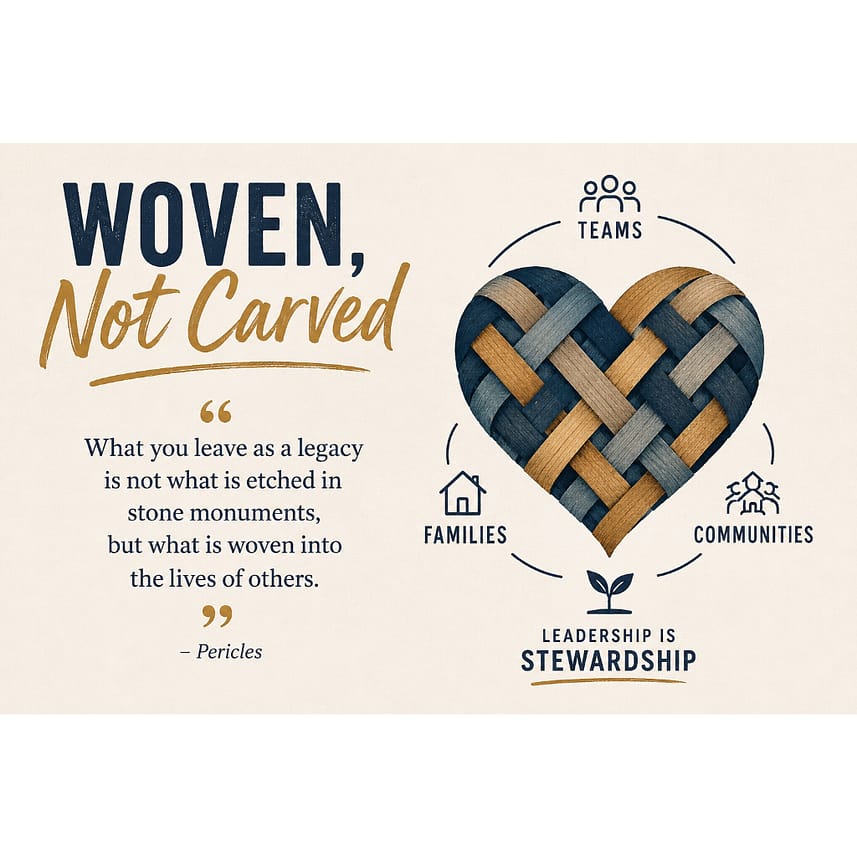
Woven Into the Lives of Others
By Nick Aitoro
In his Funeral Oration, recorded by Thucydides, Pericles told a grieving Athens that the truest memorial of a life is not carved in stone but lives on, unseen, woven into the lives of others. The familiar one-line version of that idea is a modern paraphrase, but the thought is his, and it becomes even more profound through the lens of leadership.
Leadership is often misunderstood as authority, position, or visibility. Modern culture celebrates achievement, status, and personal branding. We measure leaders by profits, promotions, followers, awards, and the scale of the organizations they oversee. Yet history keeps showing us the opposite. Many people who held immense power are forgotten, while others with far less status continue shaping generations because of how they made people feel, grow, and believe in themselves.
Real leadership is deeply human, and it does not begin at the office door.
The older I get, the more I realize my why has little to do with titles or recognition or the size of my office. My why is people. It is helping others become stronger, healthier, more self-aware, and more capable than they believed possible. It is building environments where people feel safe enough to grow, accountable enough to improve, and valued enough to contribute fully. That environment is not confined to a conference room or a job site. It exists at the dinner table, in the stands at a child’s game, in how we speak to strangers, and in the energy we carry through the door at the end of a hard day. Leadership is not something we clock in and out of. It is a way of being.
That understanding did not come naturally to me.
For most of my life I moved through the world in survival mode. Independence became strength. Self-reliance became identity. Like a lot of leaders in high-pressure environments, I believed endurance was enough. Carry the burden. Absorb the stress. Solve the problem. Keep moving. But leadership built only on endurance eventually collapses into isolation, and that isolation does not stay confined to work. It follows you home.
Several years ago, after a period so difficult it nearly cost me my life, I was forced to face something I had spent years avoiding. I had been running on empty for a long time, and the people closest to me were quietly absorbing what I refused to acknowledge in myself. From the outside I still looked strong. Inside I had disconnected, from the people I was supposed to be leading and from myself. That is the thing no one warns you about. Leadership without vulnerability does not feel like weakness while you are doing it. It feels like control. And the mask, worn long enough, fuses to the face.
Brené Brown draws a line between fitting in and belonging that I did not understand until then. Fitting in means changing who you are to earn acceptance. Belonging means being fully honest about who you are and being accepted anyway. A leader performing a strength he no longer feels is not leading. He is surviving in plain sight, and everyone around him can sense the difference even when they cannot name it.
That experience changed what I believe leadership is.
The leaders who shaped me most were never the ones who projected perfection. They were the ones who were present. They listened. They challenged me without ever making me feel small. Their influence came from connection, not control, and it is the connection I remember decades later, not the authority.
Teams do not become exceptional because the people are talented. They become exceptional when people feel safe enough to be honest without fear of humiliation. Trust multiplies effectiveness. Fear suppresses it. A leader who builds relational safety unlocks creativity, accountability, and resilience. A leader who rules through fear can buy compliance for a season, but he slowly corrodes the very culture he is trying to build. The same is true at home, where fear teaches people to manage appearances instead of building character, and where withheld honesty hardens into distance exactly where closeness should be.
This is why leadership can never be reduced to metrics. Budgets matter. Reliability matters. Performance absolutely matters. But systems do not build culture. People do. And the moment an organization starts treating human beings as extensions of production, it begins losing the thing that made it worth building. Many leaders sacrifice themselves entirely to systems that would replace them within weeks if they vanished tomorrow.
Which raises the harder question. Who are you becoming in the process?
The people watching you most closely are usually not your board, your boss, or your direct reports. They are the people at home. They are watching how you handle stress, how you treat people with less power than you, and whether your actions match your words when matching them costs you something. Children especially are extraordinary observers. They are not listening to what you say about integrity. They are watching whether you live it.
Leadership requires sacrifice, but not self-erasure. Destroying yourself physically, emotionally, or spiritually in pursuit of performance does not protect the people who depend on you. It eventually harms them. Taking care of yourself is not selfish. It is stewardship of your health, your relationships, and the example you set. You cannot regulate other people while living in constant internal chaos. You cannot create safety for others out of a self that has none. I did not learn that from a book. I learned it from the seasons I ran on empty and watched the people around me carry what I would not put down.
The emotional state of a leader moves through a team faster than any policy ever will. It moves through a household faster still. Long after the projects close and the quarterly reports are forgotten, what remains is how people felt in your presence under pressure. Respected or diminished. Valued or disposable. Developed or ignored.
That is legacy. It is built in ordinary moments, in the choice of presence over distraction, honesty over performance, and compassion over convenience. Teams can survive mistakes and hard seasons. What they cannot survive is uncertainty about whether their leader means what he says. Integrity is not perfection. It is alignment. Brown calls it choosing courage over comfort, doing what is right instead of what is easy, and that is what people are reading you for, at work and at home alike.
So here is the question worth sitting with. How do you want to be known? Not professionally or publicly, but in the quiet memories people carry of you. Did they feel smaller after being around you, or stronger? Did your presence create fear, or steadiness? Did you elevate people, or protect your own ego?
Most leaders never grasp the reach of their own influence. The employee you encouraged may one day lead thousands. The person you simply listened to may decide not to give up. The child watching you at home will inherit your emotional patterns, for better or worse. Leadership ripples through generations not because of what we built, but because of what we modeled and how we made people feel about themselves.
A leader’s real monument is invisible. It lives in the confidence he helped build, the steadiness he held during uncertainty, and the courage he made possible in someone else. Titles disappear. Status fades. Performance ends. Human connection remains.
That is the philosophy I try to live by now. Not leadership as domination or ego or performance, but leadership as stewardship. Of teams. Of families. Of communities. Of the next generation watching all of us right now.
Because the greatest legacy is never carved into stone. It is woven into the lives of the people we touched, in every moment we chose to show up as our truest selves.
Reference list
Brown, B. (2010). The gifts of imperfection: Let go of who you think you’re supposed to be and embrace who you are. Hazelden.
Brown, B. (2017). Braving the wilderness: The quest for true belonging and the courage to stand alone. Random House.
Thucydides. (1874). History of the Peloponnesian War (R. Crawley, Trans.). Longmans, Green. (Original work published ca. 431 B.C.E.)