
You Can’t Kill an Idea
September 13, 2025
How Strategic Leadership is Shaping the Future of the Indian Gaming Industry
September 18, 2025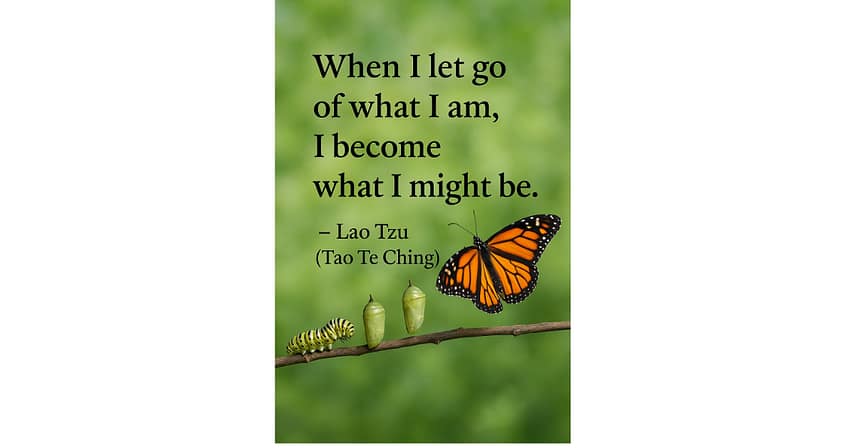
The Cost of Ascent: Surrender as the Path to Transformation
By Nick Aitoro
“Nothing is attained without surrender; every ascent requires the release of the old, and even paradise is entered through mortality.”
Human beings are wired to hold on. We clutch at comfort, security, identity, and familiarity, even when these no longer serve us. We tell ourselves that safety lies in grasping tighter, but the truth is that growth often begins with loosening our grip.
At its heart, transformation is not about gaining more—it is about surrendering. And this paradox, that ascent requires release, is found across many of the world’s great paths and philosophies.
Buddhism teaches that liberation comes through releasing attachment. Christianity calls for dying to self in order to be reborn. In Hinduism, moksha is attained by loosening the grip of ego and merging with the eternal. In Sufi Islam, the mystic’s journey is one of surrender to the Beloved, dissolving the self in divine love. Taoism counsels letting go of control, flowing with the Way rather than striving against it. Even Stoic philosophy reminds us that freedom comes not by clinging, but by accepting what is beyond our power. And Jungian psychology teaches that individuation requires surrendering the ego’s illusions and integrating the shadow, releasing fragmentation in order to rise into wholeness.
Across cultures and centuries, the wisdom is the same: to rise, we must first release.
The Buddhist Path of Letting Go
In Buddhism, the root of suffering is attachment—our insistence on clinging to things as though they were permanent. The Buddha taught that freedom comes through letting go of craving, aversion, and delusion.
Siddhartha Gautama was a prince who had every worldly possession, yet he abandoned them all to seek truth. Sitting beneath the Bodhi tree, his enlightenment came not through acquiring new knowledge but through releasing illusions of self and desire. His final awakening was a death of ego, a surrender of grasping, which opened the way to Nirvana.
This truth extends to us: every step upward requires a letting go. We cannot rise into freedom while weighed down by what we cling to. Release is not loss—it is liberation.
The Biblical Pattern of Death and Renewal
Christian Scripture mirrors this paradox in powerful ways. Jesus tells his disciples: “Unless a grain of wheat falls into the ground and dies, it remains alone; but if it dies, it bears much fruit” (John 12:24). The message is clear: life emerges from death, gain comes through surrender, and resurrection is possible only after crucifixion.
The Apostle Paul echoes this when he writes, “Therefore, if anyone is in Christ, the new creation has come: the old has gone, the new is here” (2 Corinthians 5:17). To step into new life requires laying down the old. Even salvation itself requires the ultimate surrender: mortality. We enter paradise only by passing through death.
The Biblical narrative is not about clinging, but about releasing—releasing control, ego, self-sufficiency—and trusting that what is given up is the very soil in which new life grows.
Jung and the Surrender to Wholeness
Carl Jung added another dimension to this universal pattern: the work of integration. He saw transformation not in rejecting or denying the darker parts of ourselves, but in surrendering our illusion of control over them and bringing them into consciousness.
To ascend, we must integrate the shadow. Individuation—the process of becoming whole—requires us to let go of the ego’s tight grip on identity and instead welcome the hidden, disowned parts of ourselves. Only by embracing and integrating what we once resisted can we rise into true selfhood.
In Jung’s philosophy, surrender is not passive resignation but the courageous act of yielding to what is real within us—light and dark, conscious and unconscious. Integration is its own form of release: the death of fragmentation, the rebirth of wholeness.
The Universal Rhythm of Surrender
Whether in Eastern or Western thought, in mysticism or psychology, the pattern is the same: ascent demands surrender.
- The climber must set down extra weight to reach the peak.
- The gardener must prune branches to bring forth more fruit.
- The soul must relinquish ego to taste freedom.
- The believer must pass through death to enter paradise.
- The self must release its illusions to be made whole.
Every gain has a cost. But what feels like death is often the seed of rebirth. Loss creates space for renewal. Release opens the way to transformation.
The Doorway Metaphor
A friend once put it this way: think of your life as a house. You entered through one door, and ahead of you is another. But that new door will not open until the one behind you is closed.
You may long to discover what lies ahead, but as long as you leave the past ajar, you remain trapped in the hallway. Closing the old door does not erase what’s behind it—it simply allows you to step fully into the next room of your life.
The Courage to Let Go
This is why surrender is not weakness but strength. To unclench the fist, to open the hand, to release what we believe defines us—this is the bravest act of all.
In our lives, surrender may take many forms: leaving behind a toxic relationship, shedding an old identity, forgiving someone who has wronged us, or letting go of fears that hold us back. Each act feels like a small death. Yet in these deaths lies the possibility of new life.
When we refuse surrender, we remain stuck. But when we accept it, we enter into the ancient rhythm woven into both spirit and nature: death and resurrection, release and renewal, letting go and rising higher.
The Question for Us
The wisdom is timeless:
- The Buddha shows us that freedom is born from non-attachment.
- Christ reveals that new life comes only through death and resurrection.
- Hinduism, Islam, Taoism, and Stoicism all echo the call to release.
- Jung reminds us that even our own wholeness requires surrender to the parts of ourselves we resist.
- Nature itself teaches that loss precedes renewal.
All of them point to the same truth: nothing is attained without surrender.
So the question is not whether surrender is required—it always is. The question is:
What door must I close, what weight must I release, what shadow must I embrace today, in order to rise tomorrow?