
Daddy’s Love
September 19, 2025
The Sound of Inner Conflict
September 21, 2025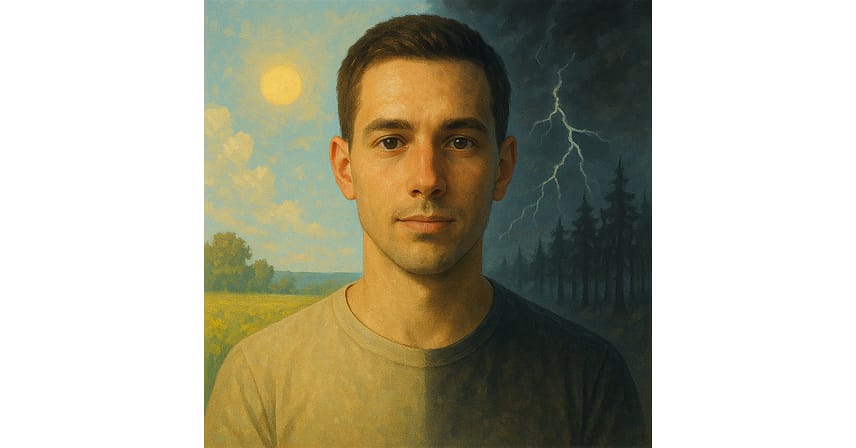
My Duality, My Wholeness: A Story of Letting Go
By Nick Aitoro
There are moments in life when surrender stops being an abstract idea and becomes an embodied reality—when the body speaks what words cannot, and the soul finds release through letting go. For me, that moment came during somatic work with Lifespan Integration therapy. It was the first time I stood face-to-face with all of me—the good and the bad, the fun and the ugly, the giving and the depraved. All of it belongs. All of it is me.
The Body Remembers What the Mind Forgets
Trauma does not simply disappear. It lingers in the nervous system, etched into muscle memory, breath, and posture. The conscious mind may suppress or forget, but the body carries the story. Like the subconscious, the body never forgets.
As Bessel van der Kolk reminds us in The Body Keeps the Score, trauma is not just a memory locked in the past—it is a living imprint on the brain and body, shaping how we see the world, how we feel in our own skin, and how we respond to life. The body quite literally keeps score, holding on until it is given permission to release.
In therapy, I was asked to recall a memory from each year of my life. At first, it felt like reciting a timeline. Each time a memory was read aloud, I held a rolled towel in my hands, eyes closed, listening with focus. Again and again, the images surfaced—and my body began to respond. My chest tightened, my hands trembled, heat rose in my face, and a lump formed in my throat. Yet when I recalled moments of joy, I felt lightness, softness, love, and freedom. Over and over, I could feel the texture and color of the events.
This was not magic, not mystical—it was biological. The severed connection between my mind and body had begun to repair, and they were communicating again. These were not just memories; they were parts of me still waiting to be acknowledged.
Bruce Lipton, in The Biology of Belief, teaches that our cells respond to our perceptions and beliefs. Trauma, carried as a lens of fear or unworthiness, programs the body at the cellular level. To heal, we must re-pattern not only thought but belief. In those sessions, I began that rewriting: telling my body a new story—one of survival, dignity, freedom, and self-empowerment.
Memories of my younger selves carried more weight than I expected. As my therapist spoke each event aloud, grief, anger, and rage pulsed through my body in waves. It was exhausting. It was raw. My conscience, subconscious, and body collided in a perfect storm. I learned to ride the wave—to feel the emotions, endure the sensations, and stay with my body. Too often we disconnect, disengage, bury, and try to forget when these feelings wash over us.
No one teaches us how to fully, deeply, and truly process the whole spectrum of emotions—negative, neutral, and positive alike. But when the storm finally passed, there was silence—not the silence of emptiness, but of peace.
And it wasn’t only the child within me who needed a voice. I also wrote to the abusers, the users, and the unkind—the ones who had left scars on my story. I told them the truth I had swallowed for years: what they did was wrong, it caused harm, and it would not define me any longer. In naming it, I reclaimed power. In speaking it, I cut the cords that had bound me in silence.
These letters were not for them—they were for me. A way of releasing the poison I had carried, a way of saying: I see it now, I survived it, I didn’t have to like it—and I am free.
A Meeting Beneath the Surface
Through those sessions, I met the boy who had once felt powerless. I met the teenager who wore bravado like armor. I met the young man who believed strength meant carrying burdens in secret. Each of them was still alive within me, still shaping how I reacted to everyday events, how I treated people, and how I loved people.
And in meeting them, I embraced them. I told them what they had waited to hear: You are not forgotten. You are not alone. What happened to you was not your fault. And you are free now.
Carl Jung spoke of the shadow—the hidden, repressed, or disowned parts of ourselves that we banish into darkness. He taught that true wholeness comes not by denying the shadow, but by integrating it into the Self.
What I experienced in those days was exactly that: the shadows of my past selves, and the dark figures of my story, stepping out from exile and finding a home in the light of truth. To meet them was to integrate them; to integrate them was to reclaim my life.
Letting Go, Becoming Whole
What I let go of was not memory—it was shame. It was the illusion that strength meant silence, or that growth required disowning the parts of me I wished were different.
In Buddhist thought, clinging is the root of suffering, and freedom comes through release. In Christian scripture, resurrection follows death: “the old has gone, the new is here” (2 Corinthians 5:17). Jung adds another dimension: integration. To live authentically, we must gather our fragments—shadow and light, past and present—into a reconciled whole.
Neuroscience confirms what spiritual traditions and Jungian psychology have long intuited: when trauma remains unprocessed, the amygdala stays hypervigilant, the nervous system stays braced, and even joy can feel unsafe. Healing comes when the body learns the danger has passed, when the story is rewritten, and when belief shifts from fear to freedom.
Lifespan Integration was more than therapy; it was reunion. It was a resurrection of my forgotten selves, a confrontation with my shadow, and a reconciliation with my pain. And in that reunion, I became more whole.
Though these sessions are over now, I don’t want to suggest I have “arrived” at some final destination. Instead, I stand at a junction—a time to reap the rewards of the work, to make new plans, to learn where I am and where I want to go. This time by choice, not by circumstance. I may revisit different memories again, but until then, I can truly start living—thriving, not just surviving.
The Invitation
The day I met myself was not an ending but a threshold. I walked away lighter, freer, no longer a stranger to my own story.
Perhaps the same is true for you: there are parts of yourself—buried, silenced, hidden—that wait to be met, embraced, and welcomed home.
The wisdom is clear across traditions:
- The Buddha teaches us to let go of grasping.
- Christ calls us to die to the old self and rise anew.
- Jung reminds us that our shadow, when integrated, becomes a source of strength rather than shame.
- Van der Kolk shows us that the body must be freed from the imprint of trauma.
- Lipton reminds us that our beliefs, once transformed, reshape our very biology.
And so the invitation remains:
The only question left is this—will you step across the threshold and meet yourself?
Music feeds the soul
📚 References
Bessel van der Kolk, M.D. (2014). The Body Keeps the Score: Brain, Mind, and Body in the Healing of Trauma. Viking.
Bruce H. Lipton, Ph.D. (2005). The Biology of Belief: Unleashing the Power of Consciousness, Matter, & Miracles. Hay House.
Carl Gustav Jung. (1959). Aion: Researches into the Phenomenology of the Self. Princeton University Press.
Carl Gustav Jung. (1951). Aion and The Archetypes and the Collective Unconscious. Princeton University Press.
The Holy Bible. (2 Corinthians 5:17). New International Version.
Teachings of the Buddha. Various sources, including the Dhammapada.
**Writing and reading this was therapy itself.