

Freedom Carried Forward
November 11, 2025
More Than a Moment: The Practice of Gratitude
December 1, 2025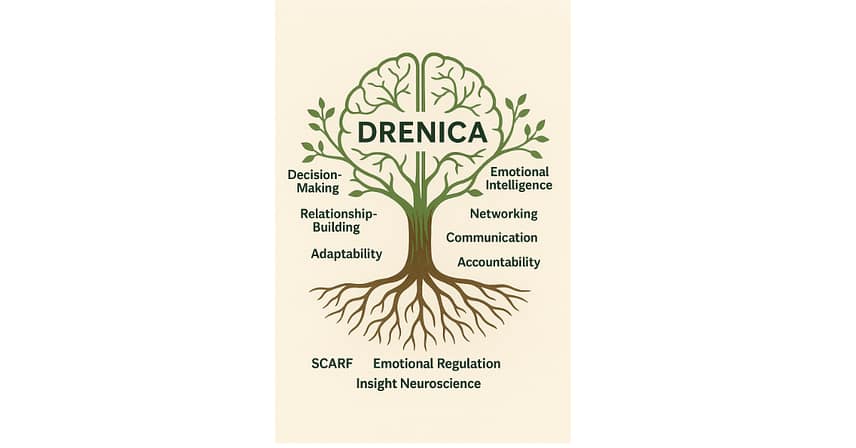
Leading With the Brain in Mind: Neuroleadership Insights for Modern Organizations
By Nick Aitoro
Neuroleadership blends cognitive neuroscience with leadership science to explain how leaders shape behavior, motivation, trust, and performance. As organizations navigate rapid change, growing complexity, and rising psychological demands, leaders increasingly require frameworks grounded not only in intuition and experience but in empirical understanding of the human brain.
A core premise of neuroleadership is that leadership effectiveness depends on how well leaders regulate social, emotional, and cognitive conditions. Research consistently shows that humans respond to leadership not simply through logic but through deeply embedded neural systems that evaluate threat, reward, fairness, and social belonging.
Among the most influential frameworks in the field are Rock’s SCARF model, Lieberman’s research on emotional regulation, the neuroscience of insight, and Çitaku’s DRENICA Model of Leadership Competencies. Together, these perspectives form a rich, interdisciplinary foundation for understanding how leaders influence the inner workings of human performance.
The SCARF Model as a Foundation for Brain-Sensitive Leadership
David Rock’s SCARF model identifies five domains—Status, Certainty, Autonomy, Relatedness, and Fairness—that strongly influence whether people interpret workplace interactions as threats or rewards. Because the brain’s threat circuits activate more quickly and intensely than its reward circuits, leaders who understand SCARF can shape environments where people think more clearly, collaborate more effectively, and adapt more easily.
Status
Recognition, meaningful contribution, and influence elevate the brain’s reward response. Leaders who offer sincere acknowledgement and invite input reduce defensiveness and strengthen engagement.
Certainty
The brain prefers predictability. Clear expectations, transparent communication, and consistent processes support cognitive clarity and reduce stress.
Autonomy
A sense of control boosts intrinsic motivation. Allowing reasonable freedom within boundaries strengthens initiative and creativity.
Relatedness
Humans are wired for social safety. Trust, empathy, and connection lower defensive states and increase collaboration.
Fairness
Perceived justice and equity are powerful motivators. Transparent processes, consistent decision-making, and explained rationale build trust and credibility.
The SCARF model provides leaders a map for designing climates where people remain in a reward-oriented “approach state” rather than a defensive “avoid state,” enabling higher performance, resilience, and creativity.
Emotional Regulation: Labeling and Reappraisal as Leadership Skills
Lieberman and colleagues (2007) demonstrated that affect labeling—putting feelings into words—reduces amygdala activation and increases access to rational thought. Simply acknowledging emotions (“I’m noticing frustration rising”) restores clarity and self-control.
Similarly, reappraisal—reframing a challenge—transforms threat responses into problem-solving responses. Leaders who practice and model reappraisal help teams improve decision-making under pressure, manage conflict more effectively, and remain composed during rapid change.
In highly dynamic environments, these two skills—labeling and reappraisal—are among the most potent tools for maintaining psychological safety and collective composure.
The Eureka Effect: How Leaders Create Conditions for Insight
Insights, or “aha moments,” are critical in strategic thinking, innovation, and problem-solving. Danek et al. (2014) showed that high-intensity insights carry emotional resonance, motivational momentum, and long-term behavioral impact.
Insight arises most readily when leaders:
- Create moments of cognitive quiet
- Reduce overstimulation and information overload
- Encourage reflection rather than rushing into immediate action
- Offer alternative frames or visual representations of problems
- Invite diverse perspectives
These practices allow teams to shift from linear problem-solving to non-linear insight, yielding solutions that are more creative, resilient, and elegant.
The Neuroscience of Insight: Gamma Waves and Cognitive Readiness
Kounios and Beeman (2014) discovered that bursts of gamma-band activity often precede breakthroughs in thinking. These bursts appear after brief periods of reduced sensory input, suggesting that insight requires cognitive space.
Effective leaders understand this and avoid the trap of constant urgency. They model calm presence, protect deep-thinking time, and intentionally build rhythms that make insight more likely.
When leaders cultivate stillness before strategy, they unlock a deeper cognitive reservoir within themselves and their teams.
Integrating IQ, EQ, and MQ in Modern Leadership
Contemporary leadership demands a balance of:
- Cognitive Intelligence (IQ) for analysis, planning, and complex reasoning
- Emotional Intelligence (EQ) for empathy, communication, and relationship-building
- Motivational Intelligence (MQ) for inspiring sustained engagement and purpose
Neuroleadership shows that none of these operate independently. The brain integrates them continuously, and effective leaders learn to harmonize them in ways that support clarity, trust, and long-term performance.
The DRENICA Model: Competencies for Scientifically Grounded Leadership
While SCARF explains the neurological factors that influence behavior, the DRENICA Model (Çitaku and Ramadani, 2020; Çitaku and Ramadani, 2024) provides a complementary framework that translates leadership into measurable competencies. DRENICA identifies seven core competencies validated across global leadership populations:
1. Decision-Making
The ability to make timely, evidence-based, and ethically grounded decisions. Neuroleadership enhances this by reducing threat responses that cloud judgment and by promoting cognitive clarity through certainty and emotional regulation.
2. Relationship-Building
The skill of cultivating trust, rapport, and positive social bonds. This aligns directly with SCARF’s “Relatedness” domain and with the neuroscience of social safety.
3. Emotional Intelligence
The capacity to recognize, understand, and manage emotions. Neuroscience deepens this by identifying the mechanisms—like affect labeling—that strengthen emotional regulation and interpersonal awareness.
4. Networking
The ability to build and leverage professional connections. Relatedness, fairness, and status all influence how networks form and how influence flows within social systems.
5. Communication
Clear, consistent, and empathetic communication supports certainty, fairness, and trust. Neuroscience shows that communication isn’t just informational—it is neurological.
6. Adaptability
The ability to adjust to change with flexibility and composure. Emotional reappraisal, cognitive quiet, and insight priming all reinforce adaptability at the neurological level.
7. Accountability
Recently added in updated DRENICA literature, accountability ensures reliability, ethical consistency, and follow-through. Neuroscience reinforces accountability by explaining how fairness, clarity, and status drive ownership and integrity.
Why DRENICA Complements Neuroleadership
Where SCARF describes why people respond the way they do, DRENICA describes how leaders must behave to generate consistent excellence. Together, they offer:
- A brain-based explanation of human motivation
- A behavioral competency model for developing leaders
- A framework that bridges science, practice, and measurable outcomes
The integration of neuroleadership and DRENICA allows leadership to evolve from an intuitive craft into an applied science.
Leadership vs. Management Through a Neuroscientific Lens
Kotter’s (1990) distinction between leadership and management becomes even clearer when viewed through a neurocognitive lens.
Management
Ensures stability, predictability, and control. It aligns with SCARF’s need for certainty and fairness.
Leadership
Inspires direction, trust, and adaptability. It activates the brain’s reward networks associated with status, autonomy, and relatedness, while leveraging competencies within the DRENICA model.
Management prevents failure.
Leadership enables growth.
Modern leaders must integrate both—but neuroscience provides the keys to understanding how, when, and why each matters.
References
Danek, A. H., Fraps, T., von Müller, A., Grothe, B., and Öllinger, M. (2014). Aha! experiences leave a mark: Facilitated recall of insight solutions. Psychological Research, 78(4), 634–647. https://doi.org/10.1007/s00426-013-0514-2
Edmondson, A. (2019). The fearless organization: Creating psychological safety in the workplace for learning, innovation, and growth. Wiley.
Kotter, J. P. (1990). A force for change: How leadership differs from management. Free Press.
Kounios, J., and Beeman, M. (2014). The cognitive neuroscience of insight. Annual Review of Psychology, 65, 71–93. https://doi.org/10.1146/annurev-psych-010213-115154
Lieberman, M. D., Eisenberger, N. I., Crockett, M. J., Tom, S. M., Pfeifer, J. H., and Way, B. M. (2007). Putting feelings into words: Affect labeling disrupts amygdala activity in response to affective stimuli. Psychological Science, 18(5), 421–428. https://doi.org/10.1111/j.1467-9280.2007.01916.x
Ringleb, A. H., and Rock, D. (2008). Defining neuroleadership: A working definition. NeuroLeadership Journal, 1(1), 1–7.
Rock, D. (2008). SCARF: A brain-based model for collaborating with and influencing others. NeuroLeadership Journal.
Çitaku, F., & Ramadani, H. (2020).
Leadership competency model DRENCA: Generalizability of leadership competencies.
International Journal of Organizational Leadership, 9(1), 1–12.
Çitaku, F., & Ramadani, H. (2024).
The neuroscientific validation of the leadership competency model DRENICA.
Journal of Human Resource Management, 12(2), 43–52.